
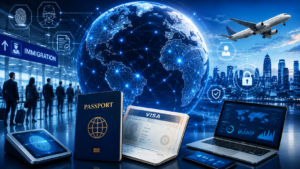
Technology is revolutionizing global visa operations by replacing manual, paper-based processes with digital applications, biometric authentication, AI-assisted document checks, and cloud-based platforms. This makes visa processing faster, more secure, and easier to manage for governments, embassies, and applicants alike.
Governments around the world are under growing pressure to process more visa applications, with fewer errors, in less time, without compromising border security. That pressure has made technology in global visa operations one of the defining themes in digital government transformation today.
For decades, visa processing depended on paper forms, physical passport stamps, and manual document checks carried out by consular staff working through long queues at visa application centres. That model is being replaced. Artificial intelligence, biometric authentication, and cloud infrastructure now sit at the center of how modern immigration authorities operate.
This shift is not theoretical. The European Union’s Entry/Exit System, a biometric border system covering 29 European countries, became fully operational in April 2026, replacing manual passport stamping with digital fingerprint and facial-image records. Its companion system, the European Travel Information and Authorisation System, is scheduled to follow in the last quarter of 2026. Together they illustrate, in real time, exactly how far government visa and border technology has moved in a very short period.
This guide breaks down exactly how that shift is happening, what technologies are driving it, and what it means for governments, travelers, and the diplomatic missions that sit between them. It also looks at where sovereign visa operations are heading next, and where organizations like Rahber Global fit into that picture.
What Are Global Visa Operations?
Global visa operations refer to the full set of processes governments use to receive, verify, assess, and approve or deny visa applications from foreign nationals, spanning everything from initial submission at a visa application centre to final biometric verification at the border.
Global visa operations cover more than issuing a stamp in a passport. They include application intake, document verification, biometric enrollment, background and security screening, decision-making, and record-keeping, often coordinated across a ministry of foreign affairs, an immigration authority, and a network of embassies and consulates in different countries.
Because these operations sit at the intersection of national security, diplomacy, and public service, they need to satisfy three demands at once: they must be secure enough to protect national borders, efficient enough to process high application volumes, and accessible enough that legitimate travelers, students, and workers are not deterred by unnecessary friction.
Why Traditional Visa Operations Need Modernization
Manual, paper-based visa systems were built for a much smaller, slower-moving world. As application volumes have grown and security expectations have risen, several structural weaknesses have become harder to ignore:
- Slow processing times: Manual document review and physical file handling create bottlenecks that are difficult to scale during peak travel seasons.
- Higher risk of human error: Manually entered data and visually inspected documents are more prone to mistakes than automated, system-verified checks.
- Limited fraud detection: Paper documents are easier to forge, and manual review cannot cross-reference data across databases the way automated systems can.
- Fragmented record-keeping: Paper files stored across different embassies and consulates make it harder to maintain a single, consistent view of an applicant’s history.
- Inconsistent applicant experience: Processes that depend heavily on individual staff availability and local infrastructure often vary significantly from one visa application centre to another.
None of this means traditional visa operations were poorly run. It means the underlying infrastructure was not designed for today’s application volumes, security expectations, or traveler expectations around speed and transparency. Modernization addresses that gap directly.
Key Technology in Global Visa Operations: The Systems Driving Change
Modern visa processing technology rarely relies on a single system. Instead, governments combine several layers of technology, each solving a different part of the process, into an integrated visa platform. Here is how the core components fit together.
Automation
Visa automation handles repetitive, rules-based tasks such as data entry validation, appointment scheduling, fee processing, and status notifications. By automating these routine steps, staff can focus their attention on cases that genuinely require judgment, rather than administrative processing.
Biometric Authentication
Biometric visa solutions capture fingerprints, facial images, or iris scans to confirm that the person applying for a visa is who they claim to be, and that the same person is the one crossing the border later. Governments generally align biometric capture with internationally recognized standards, such as the machine-readable travel document specifications published by the International Civil Aviation Organization (ICAO), so biometric data stays interoperable across different countries’ systems.
Digital Identity Verification
Digital identity verification cross-checks an applicant’s submitted documents and biometric data against trusted sources, such as national identity databases or e-passport chips, to confirm authenticity before an application is even reviewed manually. This significantly reduces reliance on visually inspecting a physical document for signs of tampering.
Cloud Infrastructure
Cloud-based visa management solutions allow embassies, consulates, and immigration authorities in different countries to access the same application data securely and in real time. This is what makes it possible for an application submitted at one visa application centre to be reviewed, escalated, or verified by staff based somewhere else entirely.
Cybersecurity
Because visa systems handle highly sensitive personal and biometric data, cybersecurity is not an optional add-on. Encryption, strict access controls, continuous monitoring, and secure data storage protocols are foundational requirements for any government visa service, not later-stage enhancements.
Data Analytics
Data analytics helps immigration authorities identify patterns, such as unusual spikes in applications from a particular region, recurring document inconsistencies, or seasonal demand trends, so that resources and staffing can be planned more effectively.
Secure Document Verification
Secure document verification technology examines the digital and physical security features of passports and supporting documents, such as embedded chips, watermarks, and holograms, to confirm authenticity far more reliably than a visual check alone.
Electronic Visa Systems
Electronic visa (e-Visa) systems let applicants submit documentation, pay fees, and receive approval entirely online for eligible traveler categories. Several governments now run established e-Visa or electronic travel authorization programs, including the United States’ ESTA, the United Kingdom’s ETA, and India’s e-Visa scheme. The European Union is preparing to launch its own version, the European Travel Information and Authorisation System (ETIAS), in the last quarter of 2026, following the same pattern most other systems have already established.
Integrated Visa Platforms
An integrated visa platform brings the technologies above together into a single operational system, connecting application intake, biometric enrollment, background screening, decision workflows, and border-crossing verification, so that data entered once is usable across the entire visa lifecycle.
Traditional vs Digital Visa Operations at a Glance
Traditional Visa Operations vs Digital Visa Operations
| Aspect | Traditional Visa Operations | Digital Visa Operations |
|---|---|---|
| Application Submission | In-person, paper forms | Online portals and e-Visa systems |
| Document Verification | Manual visual inspection | Automated, system-assisted verification |
| Biometric Capture | Limited or in-person only | Standardized digital biometric enrollment |
| Processing Time | Often several weeks | Frequently reduced to days in straightforward cases |
| Data Security | Physical file storage | Encrypted cloud-based storage with access controls |
| Record-Keeping | Fragmented across locations | Centralized and consistently accessible |
Manual vs Automated Processing
| Task | Manual Approach | Automated Approach |
|---|---|---|
| Data Entry | Staff manually retype applicant details | Data captured directly from digital forms or e-passport chips |
| Appointment Scheduling | Phone calls or in-person booking | Self-service online scheduling systems |
| Fraud Screening | Manual cross-referencing of records | System-driven pattern and anomaly detection |
| Status Updates | Applicant calls or visits for updates | Automated notifications via SMS or email |
Benefits Comparison by Stakeholder
| Stakeholder | Key Benefit | Example in Practice |
|---|---|---|
| Governments | Higher processing capacity with stronger fraud controls | Automated document checks reduce manual review workload |
| Travelers | Faster, more transparent applications | Real-time status tracking through an online portal |
| Embassies & Consulates | Consistent processes across locations | Shared cloud platform standardizes procedures globally |
Technology Comparison
| Technology | Primary Function | Value Added |
|---|---|---|
| Artificial Intelligence | Flags inconsistencies and prioritizes review | Reduces manual workload without removing human oversight |
| Biometric Authentication | Confirms applicant identity | Prevents impersonation across the visa lifecycle |
| Cloud Infrastructure | Enables real-time, shared data access | Connects embassies and authorities across borders |
| Blockchain | Creates tamper-evident records | Strengthens long-term data integrity |
Benefits for Governments
For ministries and immigration authorities, technology-enabled visa operations directly support two often competing priorities: stronger security and higher processing capacity.
- Improved fraud detection through automated document and biometric verification.
- Greater processing capacity without a proportional increase in staffing.
- Centralized data that supports better policy decisions and resource planning.
- Stronger audit trails for compliance and international reporting requirements.
- Reduced operational costs over time compared to fully manual, paper-based systems.
Benefits for Travelers
For business travelers, tourists, students, and skilled workers, the shift toward digital visa processing has a direct, everyday impact on how simple or stressful the application experience feels.
- Ability to apply from anywhere, without traveling to a visa application centre for eligible categories.
- Real-time application status tracking instead of uncertainty during processing.
- Faster decisions for straightforward, low-risk applications.
- Fewer opportunities for lost paperwork or miscommunication.
- Clearer guidance on required documents through structured online portals.
Benefits for Embassies and Consulates
Diplomatic missions sit at the operational front line of visa facilitation, and technology changes what is realistically possible for their teams to manage.
- Standardized procedures across multiple international locations.
- Reduced administrative burden on consular staff for routine applications.
- Better coordination with immigration authorities through shared, integrated platforms.
- Improved ability to manage seasonal demand spikes without proportional staffing increases.
- More consistent applicant experience regardless of which mission processes the case.
Challenges of Digital Transformation
Modernizing visa operations is not simply a matter of adopting new software. Governments face real, practical challenges in making this transition responsibly:
- Data privacy and sovereignty: Sensitive biometric and personal data must be stored and processed in line with national data protection requirements, which vary significantly between countries.
- Legacy system integration: Many immigration authorities operate older systems that were never designed to connect with modern, cloud-based platforms, making integration a genuine technical undertaking.
- Cybersecurity risk: Centralizing sensitive data increases the potential impact of a security breach, which is why layered, government-grade cybersecurity is essential rather than optional.
- Digital access gaps: Not every applicant has reliable internet access or digital literacy, so fully digital-only systems risk excluding some legitimate travelers without careful design.
- Change management: Staff accustomed to manual workflows need training and support to adopt new systems effectively, and this transition takes time to manage well.
Even large, well-resourced systems illustrate this. The EU’s Entry/Exit System took years longer than originally planned to reach full operation, precisely because biometric border infrastructure of this scale has to be phased in carefully across dozens of border points and multiple countries. That is not a reason to avoid modernization. It is a reason to pursue it with experienced partners who understand both the technology and the government context it operates within.
Future Trends in Visa Operations
The direction of travel for global visa operations is fairly consistent across regions, even as individual countries move at different speeds:
- Wider adoption of e-Visa and electronic travel authorization systems for eligible traveler categories, following the pattern already set by the United States, the United Kingdom, and India.
- Greater use of predictive analytics to anticipate application volume and allocate consular resources proactively.
- Expansion of interoperable biometric standards, making identity verification consistent across more countries’ systems.
- Increased exploration of blockchain for tamper-evident immigration records, particularly for long-term or multi-entry visas.
- Continued investment in cybersecurity infrastructure as visa systems become more centralized and data-rich.
- Growing emphasis on applicant-facing transparency, including real-time status tracking as a standard feature rather than an enhancement.
The common thread across all of these trends is a shift from visa operations being purely a government back-office function toward becoming a visible, measurable part of a country’s digital government transformation strategy.
Conclusion
Technology in global visa operations is no longer an experimental upgrade. It is the practical foundation that allows governments to process higher volumes of applications, detect fraud more reliably, and give travelers, students, and workers a clearer, faster experience, all at the same time.
Getting this right requires more than adopting new software. It requires a partner that understands the operational realities of government visa services, the sensitivity of biometric and personal data, and the importance of keeping sovereign control over how visa decisions are made.
Rahber Global works alongside governments and diplomatic missions to build secure, technology-driven visa facilitation systems that meet that standard, supporting modernization without asking any government to compromise on sovereignty or security.
Governments, ministries, and institutions exploring how to modernize their visa operations are welcome to contact Rahber Global to discuss secure, sovereign, technology-enabled visa facilitation solutions built around their specific operational needs.
FAQs
How does technology improve visa processing?
Technology improves visa processing by automating repetitive tasks, verifying documents and biometrics electronically, and enabling real-time data sharing between embassies and immigration authorities, which together reduce processing time and human error compared to manual systems.
What is digital visa processing?
Digital visa processing refers to submitting, reviewing, and approving visa applications through electronic systems rather than paper forms, often including online applications, digital document uploads, and electronic approval notifications.
How do governments use technology in visa operations?
Governments use technology in visa operations for tasks including online applications, biometric enrollment, automated document verification, fraud detection through data analytics, and secure cloud-based storage of applicant records across embassies and consulates.
What are biometric visa systems?
Biometric visa systems capture unique physical identifiers, such as fingerprints or facial scans, to confirm an applicant’s identity during the visa process and verify that the same individual is present when crossing the border later.
How does AI help visa applications?
AI helps visa applications by flagging inconsistencies, prioritizing higher-risk cases for human review, and speeding up routine checks, while final decisions remain with trained consular or immigration officers.
What is an e-Visa?
An e-Visa is an electronic visa that allows eligible travelers to apply, pay fees, and receive approval entirely online, without needing to visit a physical visa application centre or embassy in person. The United States’ ESTA and the United Kingdom’s ETA work on a similar principle.
What is ETIAS and how is it different from a visa?
ETIAS is the European Union’s upcoming electronic travel authorization for visa-exempt travelers, scheduled to launch in the last quarter of 2026. It is a pre-travel screening system, not a visa, similar in concept to the US ESTA.
Why is cybersecurity important in visa processing?
Cybersecurity is important because visa systems store highly sensitive personal and biometric data. Strong encryption and access controls prevent unauthorized access, data breaches, and misuse of applicant information.
What is a sovereign visa operations model?
A sovereign visa operations model allows a government to modernize its visa systems using outside technology and expertise while retaining full control over its data, infrastructure, and final decision-making authority.
How does blockchain apply to visa systems?
Blockchain can create tamper-evident visa and immigration records, making it more difficult to alter an applicant’s history without leaving a detectable trace, which strengthens long-term record integrity.
What challenges do governments face in visa digital transformation?
Common challenges include integrating new systems with older legacy infrastructure, protecting data privacy and sovereignty, maintaining cybersecurity at scale, and ensuring applicants without strong digital access are not excluded.
How long does digital visa processing take compared to traditional methods?
Digital visa processing often reduces processing time for straightforward applications from several weeks to just a few days, though timelines vary by country, visa category, and application complexity.
What is digital identity verification in visa processing?
Digital identity verification cross-checks an applicant’s documents and biometric data against trusted databases, such as national ID systems or e-passport chips, to confirm authenticity before manual review begins.
What role do embassies play in modern visa technology?
Embassies and consulates use modern visa technology to standardize procedures across locations, reduce administrative workload for routine applications, and coordinate more efficiently with immigration authorities through shared digital platforms.
What is the future of global visa operations?
The future of global visa operations includes wider e-Visa and electronic travel authorization adoption, greater use of predictive analytics for resource planning, expanded interoperable biometric standards, and continued investment in cybersecurity as systems become more centralized.
What is meant by technology in global visa operations?
It refers to the use of digital systems, biometrics, AI, and cloud infrastructure to manage the full visa lifecycle, from application submission to border verification, in place of manual, paper-based processes.
Is digital visa processing available in every country?
No. Adoption varies significantly by country and visa category. Many governments offer e-Visa options for certain nationalities or purposes while still requiring in-person processing for others.
Does technology replace human decision-making in visa approvals?
No. Technology supports and speeds up the process, but final approval decisions are typically made by trained consular or immigration officers, particularly for complex or higher-risk cases.
What data is collected during biometric visa enrollment?
Biometric enrollment commonly includes fingerprints and a facial photograph, and in some systems, an iris scan, used to confirm identity throughout the visa and border-crossing process.
How is applicant data protected in digital visa systems?
Data is typically protected through encryption, restricted access controls, secure cloud storage, and continuous monitoring, in line with each government’s data protection regulations.
What is a visa application centre?
A visa application centre is a facility, sometimes government-run and sometimes operated by an authorized service provider, where applicants submit documents, provide biometrics, and complete other steps of the visa process.
Can small or developing countries adopt visa technology affordably?
Yes. Cloud-based platforms often reduce the upfront infrastructure cost compared to building and maintaining legacy systems, making modernization more accessible than it was in the past.
What is the difference between automation and artificial intelligence in visa processing?
Automation handles fixed, rules-based tasks such as data entry or scheduling, while AI is used for pattern recognition tasks, such as flagging inconsistent documents or prioritizing applications for review.
How does technology help prevent visa fraud?
Technology helps prevent fraud through automated document verification, biometric matching, and data analytics that can detect unusual patterns across large volumes of applications more reliably than manual review alone.
What is an integrated visa platform?
An integrated visa platform connects application intake, biometric enrollment, background screening, and decision workflows into a single system, so applicant data is entered once and used consistently throughout the process.
Why do some governments prefer sovereign visa operations models?
Sovereign models let governments benefit from modern technology and outside expertise while retaining full ownership and control over sensitive data and final decision-making authority.
How can a government begin modernizing its visa operations?
Most governments start with a review of existing processes and technology gaps, then work with an experienced visa facilitation partner to design a phased modernization plan that fits their security and operational requirements.